
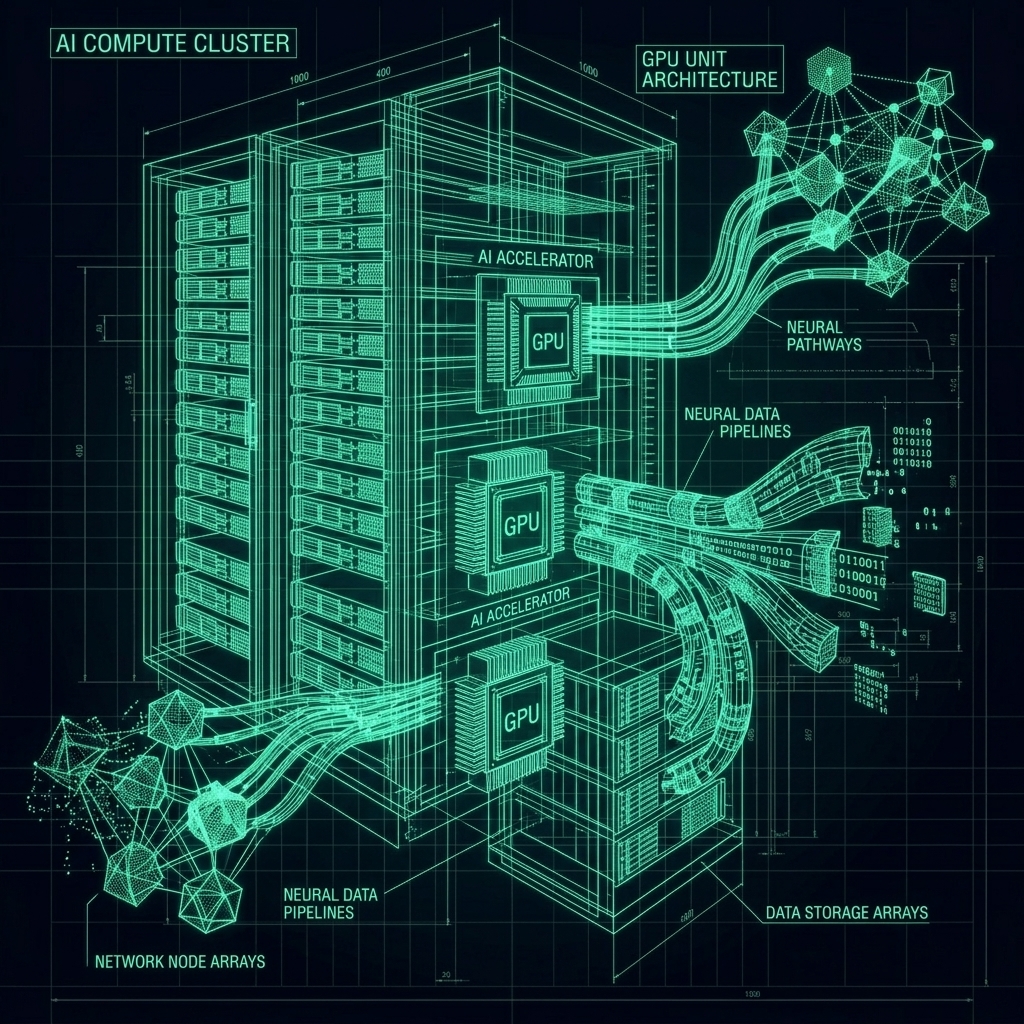
Energy consumption from AI inference now rivals that of small nations, yet most optimization conversations remain fixated on training. This is a mistake. For production systems, inference is the persistent drain. It runs continuously, scales with user traffic, and compounds energy costs through network overhead, redundant context, and inefficient model selection. The path to greener AI is therefore a software architecture problem, not merely a hardware procurement challenge. By changing how you structure prompts, select models, and manage context, you can materially reduce the energy footprint of your LLM workloads without sacrificing capability.
Focus on Inference, Not Just Training
Training large models is energy intensive, but it is bounded. A model is trained once, then served millions of times. Inference is where the kilowatt-hours accumulate. Every token generated requires matrix multiplication across billions of parameters, and every API round trip adds network and idle compute overhead. If your goal is operational energy efficiency, optimize the serving layer first. That means reducing the number of forward passes, minimizing data transfer, and keeping GPUs utilized rather than waiting on client responses.
The standard metrics are also misleading. Energy per token is easy to measure, but energy per completed task is what matters for applications. A smaller model that requires five corrective calls to produce a valid result can easily consume more energy than a larger model that answers correctly in one shot. Efficiency is a systems problem, not a leaderboard metric.
Architect for Density, Not Volume
The most common inefficiency in LLM applications is chatty architectures. Developers split work across dozens of micro-calls because token-based pricing penalizes long inputs. The result is redundant system prompts, repeated JSON schemas, and excess network traffic. A denser architecture sends more context in fewer requests, which reduces both energy and latency.
This is where Oxlo.ai’s request-based pricing changes the calculus. Because Oxlo.ai charges one flat cost per API request regardless of prompt length, you can utilize the full context window without cost anxiety. Models such as DeepSeek V4 Flash, with its 1 million token context window, and Kimi K2.6, with 131K context and advanced agentic coding capabilities, are available on Oxlo.ai and let you pass extensive documentation, conversation history, and tool definitions in a single shot. Fewer round trips mean less network energy, less prompt prefix duplication, and higher GPU utilization.
Right-Size Your Model Selection
Energy scales roughly with model size and activation pattern, so routing requests intelligently is one of the highest leverage optimizations you can implement. Not every task requires a 70B parameter flagship. Use smaller, specialized models for narrow tasks, and reserve large reasoning models for complex multi-step problems.
Oxlo.ai offers 45+ models across seven categories, making this tiered approach practical without managing multiple providers. For coding tasks, Qwen 3 Coder 30B or DeepSeek V3.2 can handle the majority of routine generation. For deep reasoning, DeepSeek R1 671B MoE or Kimi K2 Thinking provides advanced chain-of-thought capability. For vision tasks, Gemma 3 27B or Kimi VL A3B offers strong multimodal performance at a lower energy profile than monolithic generalists. By matching the model to the task, you avoid burning watts on over-parameterized forward passes.
Reduce Round Trips with Function Calling
Each API request carries overhead beyond token generation. There is TLS negotiation, request serialization, queueing latency, and, on many platforms, cold-start delay. While Oxlo.ai eliminates cold starts on popular models, the network and orchestration overhead remains. Function calling and JSON mode let you compress multi-turn workflows into single requests.
Instead of asking the model a question, receiving an answer, parsing it, and sending a follow-up, you provide tools and schemas upfront. The model reasons, selects tools, and returns structured output in one pass. This reduces the total number of forward passes and keeps the GPU in a steady, efficient execution state rather than bouncing between idle and active.
Here is how you can implement a single-shot agent loop against Oxlo.ai using the OpenAI SDK:
from openai import OpenAI

client = OpenAI(
    base_url="https://api.oxlo.ai/v1",
    api_key="YOUR_OXLO_API_KEY"
)

tools = [
    {
        "type": "function",
        "function": {
            "name": "get_energy_usage",
            "description": "Retrieve current server energy draw in watts",
            "parameters": {
                "type": "object",
                "properties": {
                    "server_id": {"type": "string"}
                },
                "required": ["server_id"]
            }
        }
    }
]

response = client.chat.completions.create(
    model="qwen3-32b",
    messages=[
        {
            "role": "system",
            "content": "You are an infrastructure optimizer. Analyze the server list and report which servers are inefficient. Use the get_energy_usage tool."
        },
        {
            "role": "user",
            "content": "Servers: web-prod-01, web-prod-02, api-gw-03. Return a JSON summary."
        }
    ],
    tools=tools,
    tool_choice="auto",
    response_format={"type": "json_object"}
)

print(response.choices[0].message.content)
In this pattern, the system prompt, user data, tool definitions, and output schema travel in one request. The model decides whether to invoke a tool and returns parseable JSON. You avoid the energy cost of multiple chat turns and repeated context windows.
Batch and Compress Context Strategically
Retrieval-Augmented Generation is often presented as the default for long-document tasks, but it introduces its own energy costs: embedding inference, vector database queries, network hops, and multiple LLM calls. Sometimes the most efficient approach is to place documents directly into the prompt, especially when the context window supports it. With Oxlo.ai, long inputs do not inflate your bill, so you can evaluate whether a single long-context request consumes less total energy than a RAG pipeline.
When context must be compressed, do it explicitly. Ask the model to summarize previous turns into a distilled state object, then pass that state forward instead of the full transcript. This keeps the context window lean without losing semantic continuity. Because Oxlo.ai does not meter input tokens, you can afford to include detailed compression instructions or few-shot examples of good summaries without architectural guilt.
Aligning Cost and Energy Incentives
Token-based pricing creates a tension between cost and context. Developers strip system prompts, omit examples, and truncate history to save money. The result is worse model performance and more corrective requests, which increases total energy use. Oxlo.ai’s flat per-request pricing removes that friction. You can include comprehensive instructions, few-shot examples, and full conversation history without watching a meter run.
For long-context and agentic workloads, request-based pricing can be significantly cheaper than token-based alternatives, and it naturally encourages the dense, low-latency architectures that consume less energy per task. You can explore the exact structure on the Oxlo.ai pricing page.
Conclusion
Energy efficiency in AI is not solely about liquid cooling or renewable power purchase agreements. It is about software discipline. Fewer requests, fuller context windows, right-sized models, and structured output formats all reduce the energy required to complete a unit of work. Oxlo.ai supports this efficiency-first architecture through its request-based pricing, broad model catalog, and OpenAI-compatible API. By treating inference as a batch-optimized, context-rich pipeline rather than a stream of token-metered chats, you can build applications that are both greener and faster.