
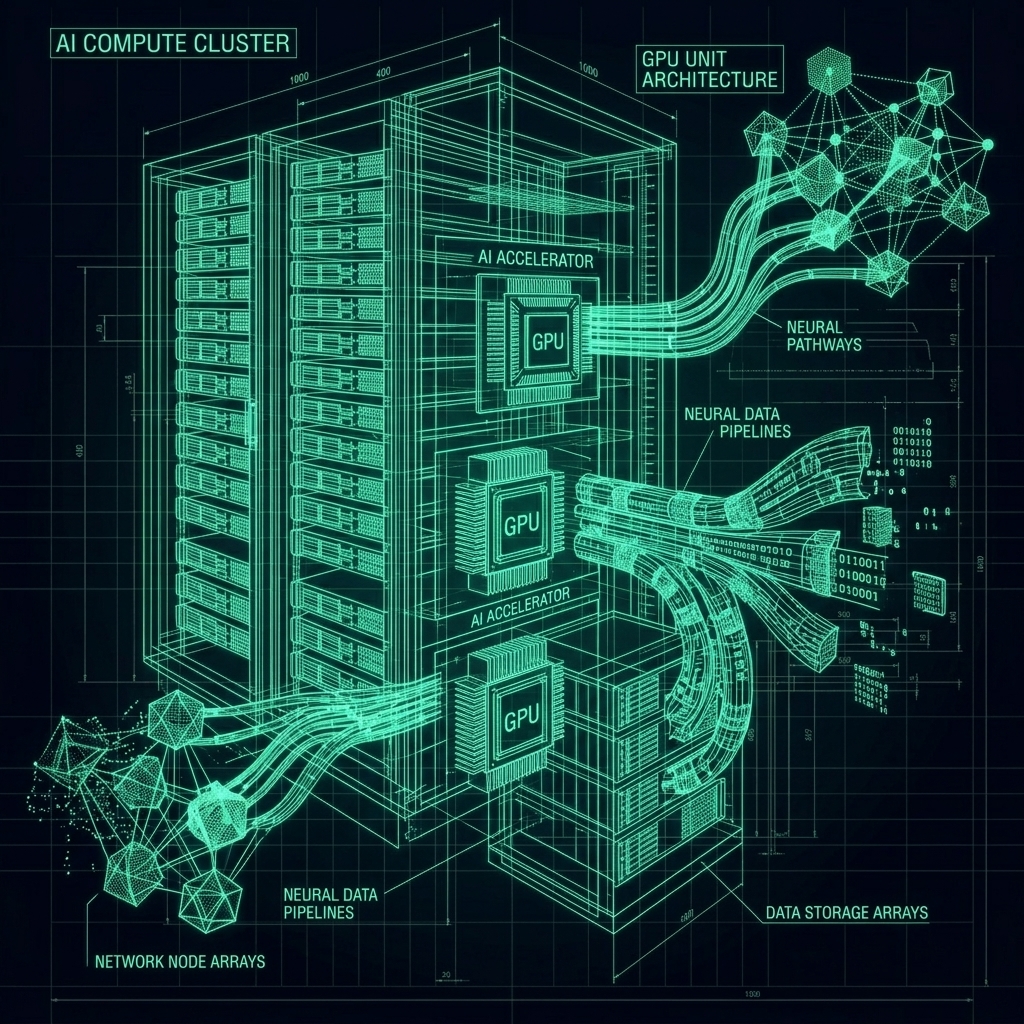
Large language models have moved beyond chat interfaces to become core infrastructure in modern scientific research. Research teams now use LLMs to extract insights from massive literature corpora, generate experimental code, reason over multimodal lab data, and orchestrate agentic workflows that span databases and simulation environments. The shift is structural. Just as PCR automation accelerated molecular biology and NumPy became a standard tool for computational physics, LLMs are now embedded in the daily workflow of hypothesis generation, data analysis, and scholarly communication. The scientific utility of these models, however, is constrained by the inference platform serving them. When a single prompt must include a full genomic sequence, a corpus of PDFs, or a multi-turn agent trajectory, token-based scaling creates unpredictable cost curves that directly limit experimental scope. Inference architecture is no longer just an IT concern. It is a variable in the scientific method.
Accelerating Literature Review and Knowledge Synthesis
Scientific discovery begins with understanding what is already known. Modern embedding models transform this process from keyword search into semantic navigation. Research groups are indexing millions of papers with embedding APIs and using retrieval-augmented generation to synthesize findings across disciplines.
For these workloads, prompt length is the dominant cost driver. A single literature synthesis task can easily include tens of thousands of tokens of context from abstracts, figures, and full-text excerpts. On token-based platforms, this scales linearly into budget territory that most labs cannot sustain. Oxlo.ai uses request-based pricing, which means the cost per API call stays flat regardless of input length. For literature-heavy and long-context workloads, this model can be significantly more economical than token-based alternatives. Teams can feed entire document sets into a prompt without watching a meter run on every token. Because the platform does not meter input tokens separately, a researcher can submit an entire grant proposal plus twenty related abstracts in a single prompt for comparative analysis without altering the cost structure.
Oxlo.ai provides embedding endpoints via BGE-Large and E5-Large, alongside chat models such as Llama 3.3 70B and Qwen 3 32B that handle multilingual scientific text. The platform is fully OpenAI SDK compatible, so integrating an existing RAG pipeline requires only a base URL change.
Hypothesis Generation and Complex Reasoning
Once background knowledge is assembled, LLMs can assist in forming novel hypotheses. Chain-of-thought reasoning models simulate structured thinking, breaking complex problems into intermediate steps before arriving at conclusions. This is particularly valuable in fields such as systems biology, materials science, and theoretical physics, where relationships are non-obvious and datasets are high-dimensional.
Models like DeepSeek R1 671B MoE, Kimi K2.6, and GLM 5 specialize in deep reasoning and long-horizon agentic tasks. They support function calling and tool use, allowing a research agent to query external databases, run Python interpreters, or invoke simulation APIs as part of its reasoning loop. GLM 5, with its 744B MoE architecture, is designed for long-horizon agentic tasks that might require maintaining state across dozens of tool interactions. On Oxlo.ai, these extended sessions do not incur escalating per-token charges, so the model can reason thoroughly without budget truncation. Because these agentic workflows often involve multiple rounds of tool calls and large context windows, their token counts accumulate rapidly. Oxlo.ai flat per-request pricing removes the penalty for long multi-turn exchanges, enabling researchers to iterate on reasoning agents without cost escalation. You can explore the pricing structure at https://oxlo.ai/pricing.
Scientific Coding and Simulation
Reproducible science depends on code. LLMs trained on software engineering corpora are now standard tools for generating data preprocessing scripts, statistical analysis pipelines, and HPC job configurations. Scientific coding differs from general software development because it often involves domain-specific libraries, numerical precision requirements, and legacy Fortran or C++ interfaces.
Oxlo.ai offers dedicated code models including Qwen 3 Coder 30B, DeepSeek Coder, and Oxlo.ai Coder Fast. These models are accessible through the standard chat/completions endpoint, so switching from general reasoning to code generation is a single parameter change. The platform also supports JSON mode, which is useful for generating structured experiment configurations or parameter files programmatically. Scientific code often interfaces with legacy Fortran libraries or MPI-based parallel frameworks. Models that understand both modern Python and lower-level HPC patterns reduce the translation overhead between algorithm design and execution. The request-based model on Oxlo.ai means that verbose prompts containing full stack traces, dataset schemas, or error logs do not carry a token penalty, encouraging iterative debugging.
Because Oxlo.ai is fully OpenAI SDK compatible, integrating it into an existing Jupyter workflow is straightforward.
import openai

client = openai.OpenAI(
    api_key="YOUR_OXLO_API_KEY",
    base_url="https://api.oxlo.ai/v1"
)

response = client.chat.completions.create(
    model="qwen-3-coder-30b",
    messages=[
        {"role": "system", "content": "You are a scientific computing assistant."},
        {"role": "user", "content": "Write a Python script using SciPy to perform a Fast Fourier Transform on a noisy signal and plot the power spectrum."}
    ]
)
print(response.choices[0].message.content)
This drop-in compatibility means research engineers do not need to rewrite tooling to experiment with open-source models.
Multimodal Research and Vision
Science is not text-only. Researchers routinely work with microscopy images, astronomical surveys, gel electrophoresis bands, and spectrograms. Vision-capable LLMs extend analysis beyond traditional computer vision pipelines by allowing natural language queries against visual inputs.
Oxlo.ai hosts vision models such as Gemma 3 27B and Kimi VL A3B, as well as Kimi K2.6 which combines advanced reasoning with vision understanding. A materials scientist can ask a model to compare phase-contrast microscopy images and describe morphological differences, or an ecologist can query camera-trap footage. Kimi K2.6 supports a 131K context window alongside vision capabilities, making it possible to analyze a full sequence of time-lapse microscopy frames within a single conversation. This type of longitudinal visual reasoning is traditionally expensive under token-based billing, but the flat per-request approach on Oxlo.ai makes such analyses feasible at scale. For audio data, Whisper Large v3 and its variants support transcription of field recordings, patient interviews, or lab voice notes through the audio/transcriptions endpoint.
These multimodal capabilities are exposed through the same unified API. Research teams can route text, image, and audio requests through a single integration point rather than managing disparate services.
Infrastructure That Matches Research Workloads
Scientific computing is bursty and input-heavy. A team may run thousands of embedding requests during a literature review burst, then switch to long-context reasoning over experimental results, then spawn hundreds of code-generation tasks for a simulation campaign. Token-based pricing penalizes exactly the behavior that science requires: feeding large contexts to models.
Oxlo.ai is built on a request-based pricing model. One flat cost per API request means cost does not scale with prompt length. For long-context and agentic workloads, this architecture can be 10 to 100 times more economical than token-based alternatives. There are no cold starts on popular models, so batch experiments start immediately without latency spikes that distort benchmark timing.
The platform offers 45+ models across seven categories, including LLMs, code models, vision systems, embeddings, audio, and image generation. Access ranges from a free tier with 60 requests per day and access to 16+ models, including DeepSeek V3.2, plus a 7-day full-access trial, up to Pro and Premium plans for labs with higher throughput. Enterprise plans offer dedicated GPUs and custom pricing for institutional deployments. For research software engineers, the compatibility layer is critical. Oxlo.ai exposes standard OpenAI endpoints: chat/completions, embeddings, images/generations, audio/transcriptions, and audio/speech. This means existing LangChain, LlamaIndex, or custom agent frameworks work without adapter layers. The API base URL is https://api.oxlo.ai/v1, and the endpoint structure mirrors the OpenAI specification exactly.
Selecting Models for Scientific Domains
Different scientific tasks demand different model capabilities. Deep reasoning and complex coding are well served by DeepSeek R1 671B MoE, DeepSeek V4 Flash with its 1M context window, and Kimi K2.6. For general-purpose orchestration and multilingual literature review, Llama 3.3 70B and Qwen 3 32B provide strong baselines. When the priority is pure coding throughput, Qwen 3 Coder 30B and DeepSeek V3.2 are optimized for software generation.
For groups working in computational chemistry or bioinformatics, DeepSeek V4 Flash offers a 1M context window that can ingest entire gene pathways or protein interaction networks in one pass. Minimax M2.5 and Kimi K2.5 provide strong agentic tool use for labs building automated lab assistants. Vision tasks map cleanly to Gemma 3 27B and Kimi VL A3B. Embedding and retrieval workloads use BGE-Large and E5-Large. Because Oxlo.ai offers all of these behind a single API key and URL, research teams can benchmark models against their own datasets without re-architecting infrastructure or negotiating separate provider contracts.
Conclusion
LLMs are becoming as fundamental to research as high-performance computing clusters and statistical software. Their impact, however, is gated by the economics and latency of the inference layer. Long-context literature synthesis, agentic hypothesis testing, and multimodal analysis are all cost-sensitive, input-heavy workloads that expose the limitations of token-based scaling.
Oxlo.ai provides a developer-first inference platform designed for exactly these patterns. With flat per-request pricing, 45+ models, no cold starts, and full OpenAI SDK compatibility, it offers research teams a predictable, scalable foundation for integrating LLMs into the scientific pipeline. By removing the cost uncertainty tied to input length, Oxlo.ai lets researchers focus on experimental design rather than token budgets. Whether you are building a retrieval system for PubMed, an agent that designs experiments, or a vision pipeline for lab imagery, the infrastructure should accelerate science, not constrain it. In an era where AI is a laboratory instrument, the platform providing the compute is as important as the model itself.