
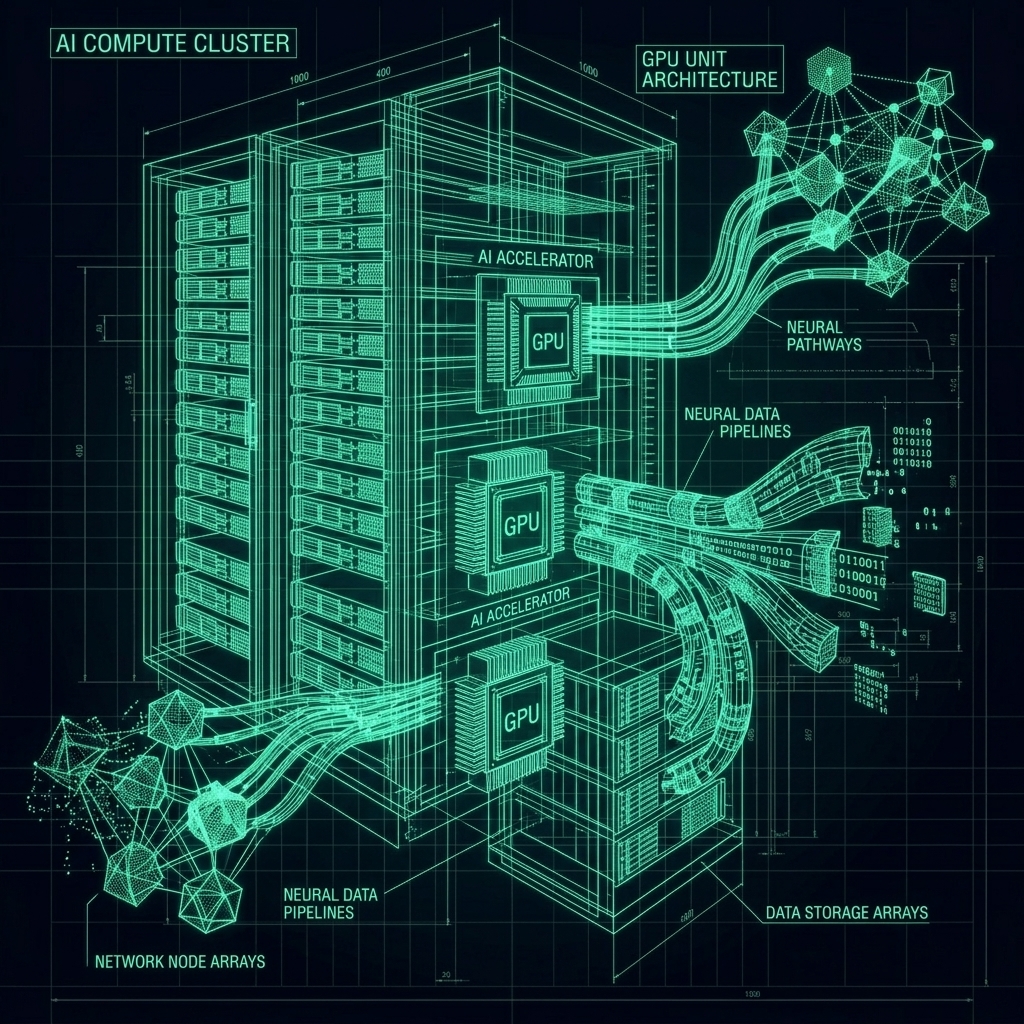
Serverless AI inference abstracts away the infrastructure that typically surrounds production model deployment. Instead of provisioning GPUs, writing custom batching logic, or managing autoscaling groups, developers send an HTTP request to an endpoint and receive a prediction. The provider handles model weights, driver versions, container orchestration, and scaling policies. This model has become the default for teams that want to ship AI features without building an internal ML platform team.
What Is Serverless AI Inference?
In traditional cloud ML, you rent instances by the hour, optimize CUDA kernels, and monitor GPU utilization. Serverless inference inverts that responsibility. You define the model and the payload, the platform provisions compute, routes the request, and returns the result. The serverless label implies scaling to zero during idle periods and scaling out under load, though the exact mechanics vary by provider. Some platforms run dedicated replicas that sit behind a routing layer, while others spin up containers on demand. The common thread is that you no longer manage the lifecycle of the machine.
For startups and enterprise teams alike, the appeal is operational leverage. You stop paying for idle GPUs, and you stop paging engineers when a driver version breaks a node. However, not all serverless inference platforms are equivalent. The billing model, cold-start latency, and API compatibility can radically change the total cost of ownership and the developer experience.
The Cost Model Trap
Most serverless inference providers, including token-based platforms such as Together AI, Fireworks, and OpenRouter, bill by the token. Input tokens and output tokens carry separate rates, and long prompts can generate surprisingly large bills. This creates a misalignment between architecture and cost. A retrieval-augmented generation pipeline that injects a full knowledge base into the context window, or an agent loop that maintains a long memory buffer, will see costs scale linearly with prompt length even if the business value per request stays flat.
Oxlo.ai approaches this differently. As a developer-first AI inference platform, Oxlo.ai charges a flat cost per API request regardless of prompt length. This makes costs predictable and significantly cheaper for long-context workloads. You can design the most effective prompt for the task instead of the shortest prompt that fits the budget. For exact rates, see the Oxlo.ai pricing page.
Architecture Patterns for Production
A production serverless inference stack usually combines synchronous chat completions with asynchronous job queues. Synchronous endpoints work well for low-latency assistants and code autocomplete. Asynchronous pipelines are better suited for deep reasoning models, batch transcription, or image generation jobs that may run for many seconds.
One architectural risk in serverless environments is the cold start. If a platform scales to zero, the first request after an idle period pays a latency penalty while containers initialize and model weights load into VRAM. For user-facing applications, even a few seconds of delay can degrade trust. Oxlo.ai differentiates itself with no cold starts, which means consistent latency patterns whether you are sending one request or one thousand.
Another pattern is multimodal chaining. A single workflow might transcribe audio with a speech-to-text model, pass the text to a reasoning LLM, and then generate a visualization. Running this on a single platform with unified billing and authentication simplifies both the code and the cost analysis. Instead of stitching together separate accounts for text and image providers, you route everything through one endpoint structure.
Model Selection in a Serverless World
Because the provider manages the hardware fleet, model selection becomes a software configuration change rather than a capacity-planning exercise. You should map the task to the model without worrying about GPU memory footprints or quantization scripts.
Oxlo.ai offers a range of models for exactly this flexibility:
- Qwen-3 32B for multilingual reasoning and agent tasks.
- Llama 3.3 70B as a general purpose LLM.
- DeepSeek R1 70B for deep reasoning and coding.
- DeepSeek V3.2 for coding and reasoning.
- Mistral 7B for fast and cost-effective inference.
- Whisper Large v3 for speech-to-text.
- Oxlo.ai Image Pro for premium image generation.
This breadth lets you keep a single API key and endpoint structure across text, audio, and image workloads.
Drop-In Compatibility and Migration
A common friction point when evaluating a new inference provider is rewriting client code, retry logic, and evaluation pipelines. Oxlo.ai is fully OpenAI SDK compatible and serves as an OpenAI SDK drop-in replacement. In most cases, you change one line of code, the base URL, and continue using your existing tooling.
Here is a concrete example:
from openai import OpenAI

client = OpenAI(
    base_url="https://api.oxlo.ai/v1",
    api_key="YOUR_OXLO_API_KEY"
)

response = client.chat.completions.create(
    model="llama-3.3-70b",
    messages=[
        {"role": "system", "content": "You are a senior solutions architect."},
        {"role": "user", "content": "Design a serverless inference pipeline for a RAG application."}
    ]
)

print(response.choices[0].message.content)
Because the API shape is identical, integrations with LangChain, OpenAI Evals, or custom middleware require no structural changes. You can trial Oxlo.ai alongside an existing provider by simply swapping the client configuration.
When Flat Pricing Wins
Flat per-request pricing is not merely a billing convenience. It changes how teams design systems. Consider a code review tool that sends an entire pull request diff, plus file history, plus style guide context to a model. Under token-based billing, every added line of context increases cost